‘It was a relief when my ex-footballer husband died after CTE’
October 29, 2024
“When he died, it was a relief. He was lying in bed, couldn’t talk, couldn’t eat, laid there with a nappy on. No-one would want to live like that, and I didn’t want him to live like that.”
Sue Bird’s final years married to former Mansfield Town defender Kevin Bird were marred by grief and violence.
Warning: This article contains references to suicide
Her loving husband’s personality was decimated by dementia and he was finally sectioned in 2020. He never came home and died in February 2023.
Like the Bird family, Tina White began to worry about her husband Goff – a one-time semi-professional footballer who played for Ryde, Waterlooville and Basingstoke – when he developed an erratic temper that led him to behave with uncharacteristic aggression.
“His whole personality changed. Before, he had empathy. He was a very loving and passionate man towards me. But he became a totally different person, a person that I didn’t like. One day he got really aggressive and said he wanted to kill me.
“He wasn’t Goff – we lost Goff a long time ago.”
Sue and Tina believe repeatedly heading footballs killed their husbands.
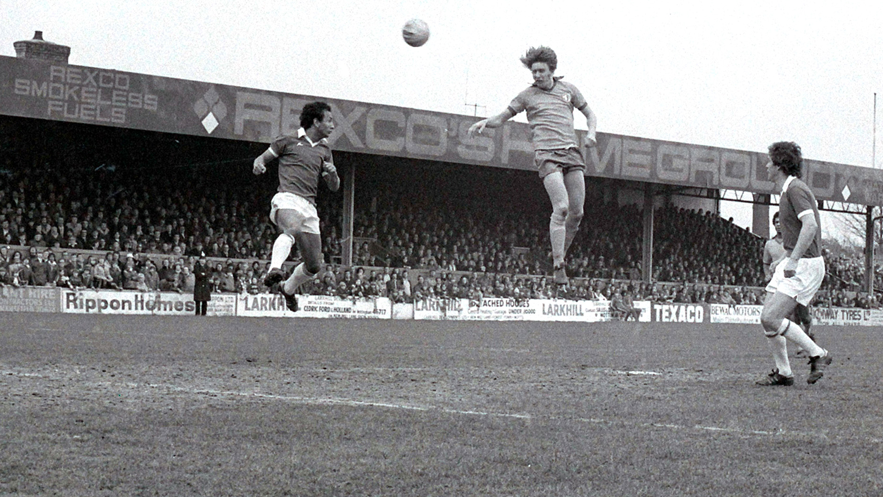
Image caption,Kevin Bird heading the ball for Mansfield Town in 1977
The Bird and White families are part of a group whose footballer relativeswere diagnosed with neurological conditions caused by chronic traumatic encephalopathy (CTE).
CTE is believed to be caused by repeated blows to the head. However, a definitive diagnosis can only be given after death, as it requires analysis of the brain.
On Friday, a group of families – also including 1966 World Cup winner Nobby Stiles’ son John – will present medical submissions to the High Court in London in the latest stage of a legal challenge being brought against the Football Association, its Welsh counterpart and international football’s lawmakers Ifab. They are taking action over what they say are brain injuries caused by repeated impacts between head and ball.
Some of the families have also written to the government to request all British sportspeople’s brains be tested for CTE after death to “force sports to adopt better protocols in respect of brain welfare” and “provide greater awareness of the risk of brain injuries for sports participants”.
BBC Sport spoke to the widows of ex-footballers about their experiences of dealing with CTE, which they say is also “an issue for the youth of today” not just “an old person’s disease”.
‘I think damage was done aged 18 to 20’
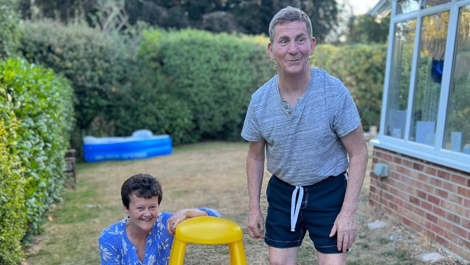
Image caption,Tina White’s husband Goff was a senior project engineer and semi-professional footballer
In the decade leading up to his death earlier this year, Goff – a senior project engineer after his early football career – changed from the “larger-than-life character who loved telling jokes” into a shell of himself.
He was unable to work, undertake basic tasks, struggled with his speech and became prone to mood swings.
“We were married for 50 years,” says Tina. “The last 10 were hell.
“Goff was a prolific header of the ball as a footballer. I think the damage was done between 18 to 20 [years old], when he got a lot of concussions. He was a very aggressive player, in there with his head, and he would practise heading for hours.”
According to the NHS, CTE can cause depression and suicidal thoughts, personality changes, and increases in erratic and violent behaviour.
For Tina and her family, the outbursts of violence Goff suffered from were devastating.
“One day he just went berserk. I locked myself in the bathroom and rang the police, but he broke the lock on the door. I ran out and luckily the neighbours had come over, so I managed to open the door to them.
“He chased after me, punched me violently and he pulled me back. I think if they hadn’t been there he would have seriously hurt me that day.
“I said to the police: ‘Please don’t lock him in a jail cell. He’s sick, not a criminal.’ Then he got sectioned. He didn’t come home after that.
“I used to go to bed and cry every night, and I remember one night I thought it would just be easier if he died. That’s how bad you feel at times.”
After Goff died, Tina donated his brain for examination by Prof Willie Stewart – the pre-eminent neuropathologist who specialises in CTE cases in sportspeople and has advised sports bodies around concussion protocols.
Prof Stewart told Tina her husband’s brain was “totally tangled up with abnormal proteins and CTE deposits”.
“Former professional footballers are at much higher risk of degenerative brain diseases, dementias and related disorders,” says Prof Stewart, who is a consultant neuropathologist at the University of Glasgow. “What we see is the risk is about three and a half times higher than it should be.”
Prof Stewart says cases of CTE can be linked to repeated impacts such as heading footballs, because the pathology of the disease differs so much from other forms of dementia.
“We see this very unique change in the brain which only appears in athletes that we don’t see in other individuals,” he adds.